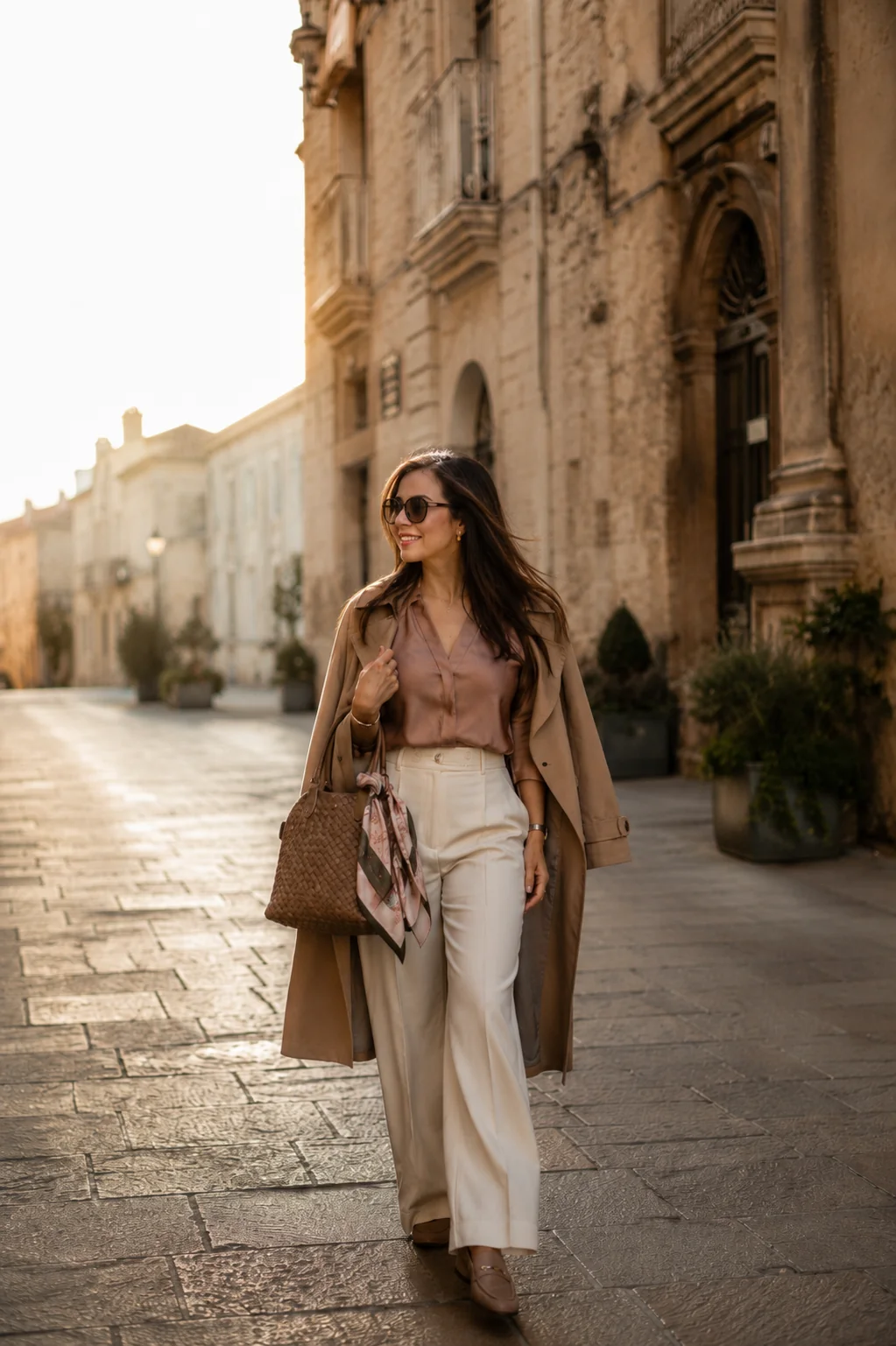
Fashion · A MonyClaire Manifesto
The trend is called muted maximalism. The real story is you, finding your way back.
This story contains affiliate links, including Amazon affiliate links. As an Amazon Associate, MonyClaire earns from qualifying purchases. If you buy through one, MonyClaire may earn a small commission at no extra cost to you.
Most of us never stopped loving color. We just got busy. Busy dressing small people before ourselves. Busy choosing practical over playful, because practical was faster and nobody was grading us on the rest. Busy deciding that beige was the responsible answer — it matched everything, asked nothing, and let us out the door in under four minutes.
And then, somewhere between the third load of laundry and a pickup we were almost late for, our closets quietly became beautifully organized hotel rooms. Calm. Coordinated. Completely without us in them.
I know that closet, because I built one. Every sweater beige, every choice responsible — until one morning I opened the doors and realized I’d spent so many years dressing small people before myself that I’d quietly dressed myself out of my own wardrobe, long before I knew fashion had a name for the way back.
Fashion noticed before we did. It didn’t abandon quiet luxury this year — it just opened the windows. The runways, the designers, even your Pinterest board have drifted toward something softer, warmer, and far more personal. They’re calling it muted maximalism. Some are calling it midimalism. The name will sort itself out. Whether people call it muted maximalism or midimalism isn’t really the point. What matters is what it’s actually offering, which is the one thing you’ve wanted all along and rarely give yourself: permission.
Quick Answer
Muted maximalism — sometimes called midimalism — combines rich textures, thoughtful layering, subtle prints, and a sophisticated, tonal color palette to create expressive outfits without overwhelming the eye. It keeps the personality of maximalism and simply turns down the volume.
What is maximalist fashion?
Maximalist fashion is a style philosophy that embraces personality through color, pattern, texture, layering, and expressive accessories. Instead of following the idea that “less is more,” maximalism celebrates thoughtful abundance — letting clothing tell a story about the person wearing it.
In 2026, that philosophy has softened into muted maximalism, sometimes called midimalism: the rich textures, layered styling, and expressive details all stay, but the color palette turns gentler and more refined. Same personality. Lower volume.
Muted Maximalism, Decoded

Two prints, one color family, and not a single piece shouting.
A striped blouse and a printed midi (pattern), a camel blazer (layering), warm neutrals held to one family (color), wool, silk, leather and suede together (texture), one woven bag and a knotted scarf (accessories). That’s the entire definition — worn.
MonyClaire • Fashion
The quiet rebellion against beige
For three years, fashion whispered. Cream sweaters, camel coats, white sneakers — everything restrained and everything lovely. Quiet luxury made a real point: good clothing outlasts trends, and a well-cut neutral will serve you for a decade. None of that was wrong.
But there’s a difference between a wardrobe that’s edited and a wardrobe that’s erased. Somewhere in the pursuit of timeless, a lot of us edited ourselves clean out of the frame. Muted maximalism is what happens when someone walks into that perfect neutral room and sets down a vase of flowers. Nothing turns chaotic. The room simply comes back to life — and so do you.
The Whole Idea, in One Room

Same careful room. One vase of flowers. Suddenly alive.
Nothing turns chaotic — a few dusty-rose blooms and a warm stack of books, and the perfectly neutral room finally looks lived in. Your closet works exactly the same way.
MonyClaire • Fashion
“There’s a difference between a wardrobe that’s edited and a wardrobe that’s erased.”
If this feels like your kind of fashion…
Beautiful things that actually survive real life.
Join MonyClaire →Classic maximalism, with the volume down
Classic maximalism is abundance on purpose: bold prints, layered textures, statement jewelry, vintage mixed with designer, an outfit that introduces you before you’ve said a word. It believes more is more, and on the right person it’s glorious. If you want to see it at full volume, those bolder maximalist fashion looks are a gorgeous world of their own — this piece is about the quieter dialect.
Muted maximalism keeps the richness and turns down the volume. If maximalism is a fireworks display, this is golden hour. Instead of neon pink, dusty rose. Instead of emerald satin, moss-green linen. Instead of ten statement pieces fighting for attention — one heirloom necklace, one silk scarf, one woven bag, one beautifully textured knit, all speaking in the same tone of voice.
The trick that makes it work is restraint of palette, not restraint of personality. You can wear an embroidered loafer, a striped trouser, a floral blouse, and a woven bag in a single outfit and read as collected rather than cluttered — as long as the colors belong to the same family. That’s the whole secret. Shared color reads as intentional. It always has.
Muted maximalism vs. minimalism, quiet luxury and full maximalism
If quiet luxury is the restrained end of the spectrum and full maximalism is the loud end, muted maximalism sits in the warm middle — expressive, but never overwhelming. Here’s how they actually differ.
| Minimalism | Quiet Luxury | Muted Maximalism | Full Maximalism | |
|---|---|---|---|---|
| Color | Black, white, grey | Cream, camel, navy | Warm, tonal, layered | Bold, bright, clashing |
| Pattern | None | Rare, subtle | One or two, tonal | Many, mixed |
| Layering | Pared back | Considered | Rich but tonal | Maximal |
| Statement | One, or none | One, understated | One memorable | Several at once |
| The feeling | Disciplined | Quiet wealth | Expressive, easy | Joyful, loud |
| Best for | Purists | Old-money calm | Real life with personality | The bold at heart |
Only one column on that chart takes you from a gallery opening to a grocery run without changing a thing.
Why this one was built for mothers
Here’s what the fashion magazines rarely say out loud: motherhood changes your relationship with getting dressed, permanently.
You stopped buying clothes for the woman who walks from a desk to a dinner reservation. You started buying for playgrounds, coffee meetings, school drop-off, weekend drives, airport security, and the family photo someone will frame for fifteen years. You need clothing that survives all of it and still looks like a choice you made on purpose.
Muted maximalism happens to be quietly, almost suspiciously practical — which is really the Real Life Luxury Test™ doing its work before you’ve even named it. Funny enough? A printed blouse survives toddler fingerprints far better than the pristine white shirt I kept trying to become. Texture hides a wrinkle. Layers make a temperature swing a non-issue. One piece of real jewelry makes a plain tee and jeans look deliberate instead of defeated. It all passes the same quiet exam — it works after the toddler hugs you, not just in the photo. The personality you were told to retire turns out to be the most functional thing in your closet.
The MonyClaire Decision Ladder™
How a beautiful wardrobe is actually built — one decision at a time.
Don’t buy more.
↓
Buy better.
↓
Buy slower.
↓
Love it longer.
↓
Live beautifully.
In real life.
Buy better, not more
This is where real-life luxury actually begins — not with buying more, but with buying with intention. Next time you’re standing in a fitting room, retire the old question. Stop asking “what does this match?” and start asking “what story does this help me tell?”
The most personal wardrobes I know contain surprisingly few clothes. A pair of wide-leg trousers in cream. A camel trench cut well enough to wear over anything. A striped sweater. An antique gold bracelet. A silk scarf picked up somewhere worth remembering. On their own, each is merely nice. Together, they’re unmistakably one person — and you already know who. If you haven’t built the neutral foundation those pieces hang on, start there first; that’s the entire point of the Elegant Mother Uniform™.
Few Things, Each One Yours

Not many pieces. Every one with a story.
A striped sweater, a printed blouse, one gold bracelet, a scarf worth keeping, the suede loafers you reach for without thinking. Nothing loud, nothing filler. That’s the whole difference between more and better.
MonyClaire • Fashion
Worth The Space™
Buy this instead
Five new sweaters
→ One printed silk blouse
A stack of cheap handbags
→ One woven leather tote
Trend-cycle jewelry
→ One heirloom gold chain
The math is rarely about money. It’s about whether a thing earns its space — and one piece you love beats five you tolerate, every single time.
Buying better is only half of the ladder; loving it longer is the rest. A silk blouse keeps its shape on proper wooden hangers instead of wire, five minutes with a handheld steamer beats an iron and a board on a weekday morning, and a fabric shaver quietly undoes a winter of pilling on a favorite knit. None of it is glamorous. All of it is the difference between a piece that lasts two seasons and one that lasts ten.
You Might Already Be One
Signs you’re already a muted maximalist
✓ You collect scarves on vacation.
✓ You’d rather own one beautiful leather bag than five trendy ones.
✓ You mix vintage with modern without thinking about it.
✓ You decorate your home with books, candles, and objects that mean something.
✓ You believe clothes should tell a story.
Nodded at three of these? You’ve been a muted maximalist for years. You just didn’t have the word for it yet.
How to try it without buying a thing
You do not need a new wardrobe. You don’t need permission to reinvent yourself. You only need permission to reveal a little more of yourself each morning. So start with one category — pick exactly one, and leave the rest alone.
Start With What You Already Own

A rack full of neutrals, and one printed thing.
She isn’t shopping. She’s reaching for the single patterned piece in a closet she already owns — the one that makes everything else look chosen. One new note, not a new wardrobe.
MonyClaire • Fashion
Texture — the lowest-effort entry. Let linen, suede, denim, cotton, leather, and knit share one outfit. Same colors, different surfaces, instant depth.
Pattern — keep every neutral you own and add one printed thing. One floral blouse. One striped sweater. One scarf. That’s the whole assignment.
Accessories — trade five forgettable small things for one memorable one. A real bag, a real necklace, a scarf with a story behind it.
Trade Five for One

Five forgettable things, or one you’ll keep for years.
A woven bag, a silk scarf with a story, the loafers you’ll re-sole twice, a little gold. Not a pile of trends — a few things chosen well enough to outlast all of them.
MonyClaire • Fashion
Color — when you’re ready, retire one black or white piece and try olive, chocolate, dusty blue, buttery yellow, terracotta, or burgundy instead. Rich without ever raising its voice.
If you do nothing else, do this: add one printed blouse to the neutrals you already own, and wear it next week. It’s the highest personality for the lowest risk, and it’s completely reversible if you hate it. You won’t.
The Framework
The MonyClaire Real Life Luxury Test™
Muted maximalism scores well here because it works past the photo. Before anything earns closet space, run it through five questions:
✓ Would I wear this to brunch and to preschool pickup?
✓ Does it mix with at least five things I already own?
✓ Will it still feel like me after the trend moves on?
✓ Would I pack it for a trip?
✓ Does it make getting dressed easier, not harder?
Five yeses and it’s in. Anything less is just a nice photo of someone else’s life.
The Bigger Picture
The Beautiful Life Index™
Here’s the part that isn’t really about clothes.
Muted maximalism is permission disguised as a trend. Permission to use color again. Permission to stop dressing purely for efficiency. Permission to be recognizable by your style instead of disappearing into it.
That’s why it lands like relief rather than work. It isn’t asking you to become someone new. It’s walking you back to the woman who was there the whole time.

Muted maximalism: your questions, answered
Is muted maximalism still in style?
Yes — and it’s still gaining ground in 2026. After several years of minimalist quiet luxury, fashion has tilted back toward warmer, more expressive dressing, and muted maximalism is the most wearable version of that shift: rich texture and a print or two, held inside a calm, tonal color palette. Its staying power is structural. It’s built on personality and well-made pieces rather than a single viral item, so it doesn’t expire when the trend cycle moves on. A wardrobe of layered neutrals with one expressive note — a printed blouse, a silk scarf, a piece of real jewelry — reads as current now and will keep reading as intentional long after the word “midimalism” fades.
Is maximalism coming back?
It already has — just in a softer dialect than the maximalism of a few years ago. Loud, full-volume maximalism never truly disappeared, but the version gaining real traction now is muted: the same richness, texture, and pattern-mixing, held inside a calm, tonal color palette instead of a clashing one. Think more is more, said quietly. The shift makes sense after years of beige minimalism — people missed color and personality but didn’t want to look costumed or chaotic. Muted maximalism hands back the expressiveness without the overwhelm, which is exactly why it’s translating from the runway into real closets rather than staying a styling-shoot fantasy.
Can a minimalist wardrobe become maximalist?
Easily — and without replacing a thing. A minimalist wardrobe is actually the ideal base for muted maximalism, because the work is additive, not a teardown. Keep your neutral foundation of well-cut basics and introduce one expressive note at a time: a single printed blouse, a silk scarf with some history, one piece of real jewelry, or a richly textured knit. Because everything stays inside the same tonal color family, the new pieces read as collected rather than cluttered. Start with one category — most people get the biggest payoff from adding a single print to neutrals they already own — and build slowly from there. You’re revealing personality, not starting over.
Is muted maximalism timeless?
More than most trends, yes — though how timeless it is depends on how you build it. Anything grounded in tonal color, genuine texture, and pieces chosen for personality rather than novelty tends to age gracefully, because it was never tied to a single season to begin with. The pieces that date fastest are the loud, of-the-moment ones; the ones that last are the printed blouse, the well-cut trench, the heirloom chain. A simple filter helps: run each piece through the Real Life Luxury Test™ — would you wear it to both brunch and school pickup, and will it still feel like you after the trend passes? If yes, it’s timeless enough to keep. If it only works for a photo, it isn’t.
How do you wear maximalism over 30?
Tonally, and with intention. Maximalism over 30 — or 40, or any age — isn’t about piling on more; it’s about fewer, better pieces in one warm color family, layered with confidence rather than novelty. The grown-up formula is simple: start from a neutral base, add one or two prints that share a palette, mix textures rather than colors, and let a single considered accessory carry the outfit. A printed midi with a camel blazer, a woven leather tote, and a silk scarf you genuinely love will read as elegant rather than costume at any age. The trick is restraint of palette, not restraint of personality — keep the colors related, and you can wear as much character as you like.
The verdict
Adopt the philosophy before you shop the wardrobe. Muted maximalism isn’t something to buy; it’s a permission slip to use what you already have with more intention. Start with one printed blouse over your existing neutrals. Run everything new through the Real Life Luxury Test™ before it comes home. Collect slowly, in one color family, and let your closet start sounding like you again.
You don’t need a new wardrobe. You need to recognize yourself again.
You were never too busy for beautiful. You were just waiting for someone to tell you it was allowed.
Maybe that’s why muted maximalism feels less like a trend and more like coming home.
To your closet.
To your creativity.
And perhaps, after all these years of dressing for everyone else…
…back to yourself.
Tomorrow morning, don’t ask what matches. Ask which version of yourself you’d like to meet again.
Join MonyClaire
Beautiful things that actually survive real life — in your inbox.
No clutter. No noise. Just the good stuff, slowly.

A MonyClaire Moment™
When I became a mother, practicality took over my closet without asking. Not because I’d stopped loving beautiful clothes — because life simply got louder than fashion, and beige let me out the door on time.
Here’s the part I don’t love admitting: for years I told myself the color could wait — that there’d be a calmer, prettier version of my life, later, that finally deserved it. There wasn’t. There was only this one, in all its laundry and noise, and me quietly dressing for a woman I kept meaning to become instead of the one already standing in the closet.
I’m finding my way back now, one intentional piece at a time. A patterned blouse instead of another plain tee. A vintage scarf knotted onto a handbag. Gold earrings that make a grocery run feel a little more like I meant it.
Maybe that’s all muted maximalism really is. Not dressing louder. Dressing closer to the woman you’ve been all along.
— Monica, Founder of MonyClaire
About the Author

Hi, I’m Monica — founder and editor of MonyClaire. I started this magazine because I was tired of choosing between a beautiful life and an honest one. Everything here gets tested against my actual life: a real home, real trips, my daughter and our Yorkie, Exxon, underfoot, and coffee that goes cold before I finish it. I believe beautiful things should survive an ordinary Tuesday — not just the photo — and if something earns its place after all that, you’ll find it here.
As an Amazon Associate, MonyClaire earns from qualifying purchases. MonyClaire is a participant in the Amazon Associates program; this post contains affiliate links, and we may earn a small commission on qualifying purchases at no extra cost to you.
Leave a Reply